
It Was “Just a Joke”… Until It Became an Identity
What if the biggest threat to your relationships isn’t conflict itself… but the perception people build about you before knowing the full story?
What Happens When Someone Defines Your Character First?
We often talk about perception in workplaces, but honestly, some of the toughest perception battles happen much closer to home.
Perception plays a powerful role in both corporate and personal life… but the impact can feel very different.
During the relationship it didn’t matter anytime, but outside of it, it does. Wish someone had told about perception management early in life.
In corporate life, false perception can hurt your image, slow your growth, and create invisible struggles. But over time, skills, capability, delivery, and experience still have a chance to speak for you.
Personal life feels much more complicated.
Because in personal relationships, people are not evaluating you based on performance or measurable outcomes. They are reacting to emotions, stories, repeated narratives, and what they keep hearing about you.
And honestly, that can be far more dangerous.
Because once a certain perception gets attached to your character, people stop seeing your actions objectively. They start seeing everything through that lens.
That is what makes personal perception battles so difficult. And what makes it even trickier is that it rarely starts with something serious.
Sometimes, it starts with something that looks completely harmless. Inside families, among relatives, and within friend circles.
Sometimes, it starts with “just a joke.”
When Jokes Write Your Reputation
Imagine this. A husband and wife visit a husband’s friend’s house for a weekend get-together. Many of your husband’s friends gather. There is potluck, lots of laughter, old friends catching up, and everyone is relaxed and casually joking around.
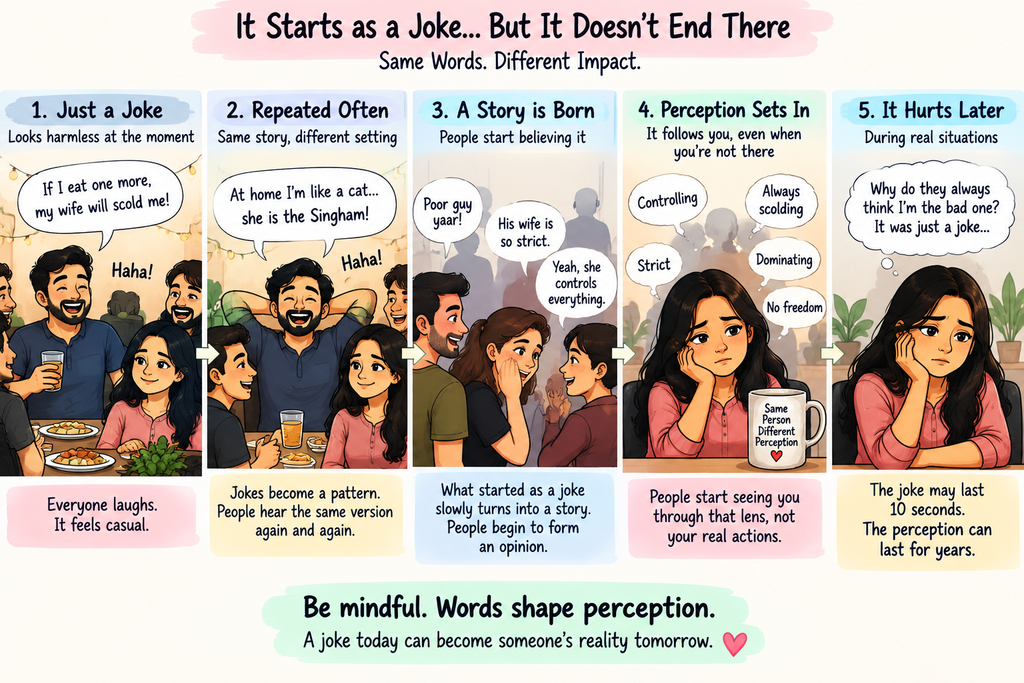
Someone offers the husband another dessert or drinks, and before even taking it, he jokes, “No no… if I eat one more, my wife will scold me.” Everyone laughs.
Or someone suggests a late-night drive, and he says, “Let me ask permission first… otherwise I am dead at home.” More laughter follows.
Then comes another joke. “At home I am like a cat… she is the Singham.” Again, everyone laughs.
Looks harmless.
Funny.
Casual.
Just friends joking around… right?
But what nobody sees is what actually happens at home. No permissions are even rejected for the husband. The wife, in turn, sacrifices her “me time” for the family. The husband, meanwhile, has his complete freedom
However, the reality is very different from the story being casually told. The wife is usually the one handling most things behind the scenes. Much of the invisible mental load quietly sits with her. Many times, she is also the first one to compromise just to maintain peace.
Most decisions are not one-sided. They are discussed and mutually agreed. The husband may not even actively manage many household things because a lot is already being handled by the wife. Yet none of that is visible in that room.
What people see is only the version being presented to them. Perception that “Husband” is poor chap and “Wife” is the remote controller. The wife was so stupid that she didn’t see this silent perception being created upon her.
When the wife confronts the same after reaching home, asking “What they will think about me”. The most smart reply is “oh that was just a joke. they will not think like that. just ignore.”
A husband jokingly positioning himself as the innocent, soft one. A wife silently gets painted as the strict, controlling one.
Slowly, that version starts becoming believable. It becomes a repeated pattern, every time, every place.
And the wife? She just sits there with a fake smile. Not because she agrees. Not because the joke is true. But because explaining in that moment feels impossible. If she interrupts and says, “That’s not true,” she immediately looks defensive.
Sometimes, the more you defend yourself, the more people assume the perception must be true. That’s probably the saddest part of it.
So she smiles, lets it pass, and says nothing. But something subtle has already happened. A perception is created.
Have you ever done that? Smiled at something that actually hurt you, simply because explaining the truth in front of everyone felt even harder?
And the person who created it may forget the joke tomorrow. The people who heard it may not.
That is the scary part about repeated jokes. Repeated jokes stop being jokes. They become stories. Stories become perception. And perception slowly becomes identity.
But the real damage doesn’t happen during the joke.
The real damage appears later. Because a joke may last 10 seconds. The perception it creates can last for years.
It shows up during a real conflict.
When Pain Gets Misread as Personality
Let me share another incident.
Before visiting the friend’s house one day, something painful had already happened between the husband and wife. The husband had said hurtful things. He had insulted her parents or/and deeply hurt her family sentiments. She was emotionally shaken and honestly did not even feel like going to a friend’s house that day.
Whether it is planned or unplanned, only GOD knows it.
She resisted going. She wanted to stay back. But slowly, it became less of a choice and more of a compulsion. So she went. Physically present… but emotionally drained. She was still carrying the pain of what had happened just before leaving home.
Now imagine walking into a room full of people while carrying that emotional weight inside. You are already hurt, already exhausted, and trying very hard to stay composed.
And then the same pattern repeats.
Someone offers him something, and once again he casually smiles and says, “No no… my wife will kill me if I do that.”
Everyone laughs.
For them, it was just another harmless joke.
But for the wife, that moment felt completely different.
Just minutes ago, she had been insulted, emotionally hurt, and forced into a social gathering she did not even want to attend. She was already operating at the edge of her emotional capacity.
This time, she could not tolerate the fake image being projected.
In the heat of the moment, she replied, “It’s Okay. Let him do whatever he wants.”
That one sentence came from pain.
From hurt.
From emotional exhaustion.
But guess how it was interpreted?
Not as pain.
Not as emotional breakdown.
Not as a reaction to what happened before.
It was interpreted as attitude, aggression, even dominance.
Some even hinted it sounded like separation. And that is exactly how perception traps you. People judged the reaction. Nobody saw the trigger. They saw one sentence. They did not see the emotional story behind that sentence.
Have you ever had someone judge your reaction without ever asking what happened before it?
But here comes the real twist. The damage is not in the reaction itself. The damage happens when people start treating that reaction as proof of the perception they already had.
Before anyone even understands what actually happened, the conclusion is already ready.
“She must have said something.”
“She is dominating anyway.”
“She probably overreacted.”
The judgment happens before the facts arrive. And once the judgment is made, facts somehow have to work twice as hard!!
Nobody pauses to ask the most important questions. What actually triggered the situation? What happened before that reaction? What was said behind closed doors? What context is missing?
That was when I realized something scary. Perception doesn’t just influence how people see your personality. It influences whose side they take during conflict.
Once that happens, the truth doesn’t stand a fair chance.
The Vikram Vedha Battle
This reminded me of a moral dilemma from Vikram Vedha. If a murder happens, who is more guilty? The person who committed it? Or the person who ordered it? There is no easy answer.
And strangely, perception feels similar to me. If someone’s identity gets damaged because of a false perception, who is more responsible? The person who created that perception? Or the people who believed it without questioning?
Slowly, that perception starts feeling like truth. And that is when it becomes really difficult to undo!!
One creates the narrative.
Another gives it power.
Together… perception starts becoming reality.
The Hard Lesson I Learned
When it comes to spouse, parents, relatives, teachers, or close friends, it becomes far more important to break false perception early. Because in personal relationships, people are not evaluating your skills or performance. They are mostly reacting to stories, emotions, and what they keep hearing repeatedly.
That is what makes it dangerous.
The relationship will never be the same again.
The next conversation will never feel the same again.
Once friends or relatives get locked into one perception about you, every future problem starts getting viewed through that same lens.
If there is an argument…
It must be because of you.
If there is tension…
You must have triggered it.
If something goes wrong…
Somehow you become the obvious reason.
The actual incident stops mattering.
The trigger stops mattering.
Context stops mattering.
The perception has already decided the verdict.
That was a hard lesson I learned.
Don’t ever let anyone, even your parents, spouse, relatives, or friends, keep building a false perception about you while you stay silent.
Be open. Communicate. Clarify your side. Explain your intent, your reasoning, and what actually triggered your reaction.
And if you don’t break that perception early…
That version may become permanent.
The biggest mistake?
Trying to fix publicly created perceptions through private conversations.
Key Takeaways on Perception
- Be careful with repeated jokes. What starts as humor can slowly become a label attached to your identity.
- Personal perception can be more dangerous than corporate perception. Family and friends often react to stories and emotions more than facts.
- People often judge reactions without understanding triggers. They see the reaction, not the pain or context behind it.
- Break false perceptions early. The longer you stay silent, the deeper that narrative becomes truth.
- Don’t fix public perception only through private 1:1 conversations.
This one is for the women who grew up in a time when “staying silent” felt easier than explaining what you were actually feeling/fight for it.