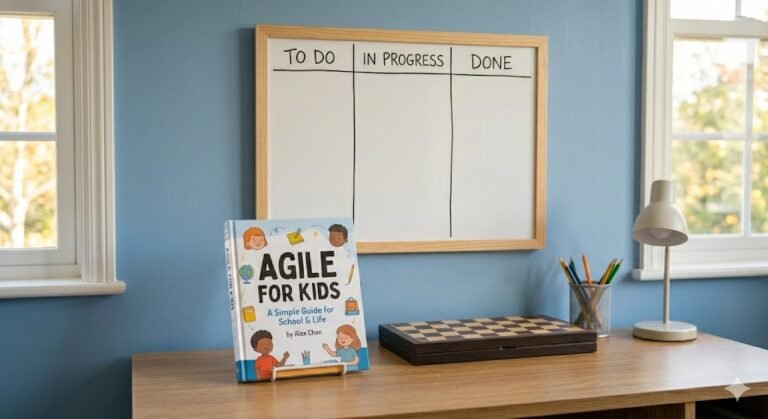
The Five Why’s Game That Changed Our Conversations
I taught my son the Agile Five Why’s technique to solve homework struggles and school morning chaos. Everything was going great… until one day he used the same technique on me!!
After trying a Kanban board and the Mad, Sad, Glad retrospective at home, I thought of introducing another simple Agile technique to him – Five Why’s.
I have seen this technique work beautifully in Scrum projects, especially during retrospectives and root cause analysis sessions. Because in Agile, we know something important.
The first problem we see is rarely the actual problem.
For example, imagine a sprint story didn’t get completed.
The first reaction is usually simple – the developer missed the deadline.
But we don’t stop there.
Why was the story delayed?
Maybe development took longer than estimated.
Why?
Requirements were unclear.
Why?
Acceptance criteria were incomplete.
Why?
The refinement discussion got skipped.
Suddenly, the problem is no longer “developer delay.” The real issue was poor backlog refinement.
That’s the power of Five Why’s.
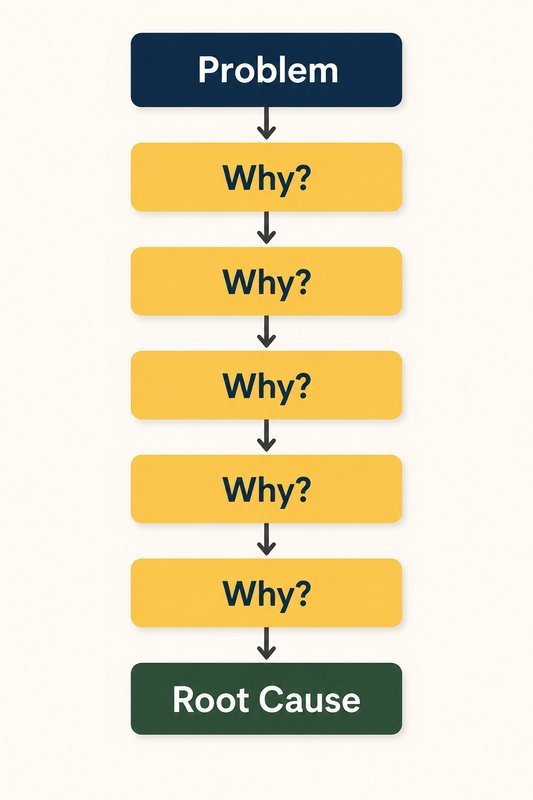
In problem-solving, we often rush to fix whatever is visible in front of us. However, many times, the visible problem is just the symptom.
Keep asking “Why?” until you uncover what is really causing the issue.
Sounds simple, right?
Trust me… applying this with children gets even more interesting. 😄
The Homework Meltdown
One evening, he came and said,
“Mummy, I don’t want to do homework.”
That made me pause.
Instead of convincing him to sit and finish it, I decided to try the Five Why’s technique.
We started asking a few “why” questions together.
As we kept asking “why”, we realised it wasn’t just about homework being difficult. There were a few things going on together – not understanding the topic properly, getting distracted in class, and simply being tired.
It wasn’t one root cause at all. It was actually multiple small issues piling up together.
The Morning Rush
One day, I asked my him,
“Why are you always getting ready till the last minute and rushing every morning? Can’t you do things a little faster so you have some breathing space before boarding the bus?”
He immediately replied,
“Mummy, I am doing everything fast only… still I am getting late. I don’t know why.”
So I told him,
“Remember the Five Why’s technique I taught you? Let’s use that now.”
We started asking a few more “why” questions.
As we kept digging, we realised the problem wasn’t that he was slow in the mornings.
A little preparation the previous night made the mornings much easier.
And just like that, the morning stress reduced automatically.
Why We Still Play the Five Why’s Game
Somewhere along the way, Five Why’s stopped being an Agile technique and became our little Five Why’s game at home.
Even today, we still play the Five Why’s game from time to time. Not just to solve problems, but also when we want to understand more than one reason behind something or simply see a situation from a different perspective.
One thing we have realised is this.
The first answer is usually not the full story.
There is often another reason.
And then another.
Sometimes, things are not as simple as they first look.
When the Five Why’s Game Turned Against Me
The funniest part? After introducing this technique at home, he slowly started understanding exactly how it works.
Then one day, completely out of nowhere, he looked at me and said,
“Mummy… you said you’ll buy that Lego set and it’s still not here. Shall we play the Five Why’s game?” 😄
I just stood there for a second.
Wow. Agile was officially being used against me.
Let’s just say a very big light bulb went on in my head. 💡
Five Why’s – My Takeaway
Five Why’s started as another Agile experiment at home. Somewhere along the way, it became a game. And then, without us realising it, it became a different way of having conversations. Sometimes to solve a problem. Sometimes to understand a feeling. And sometimes… simply to see things from another person’s perspective.
Read my other blog posts here.